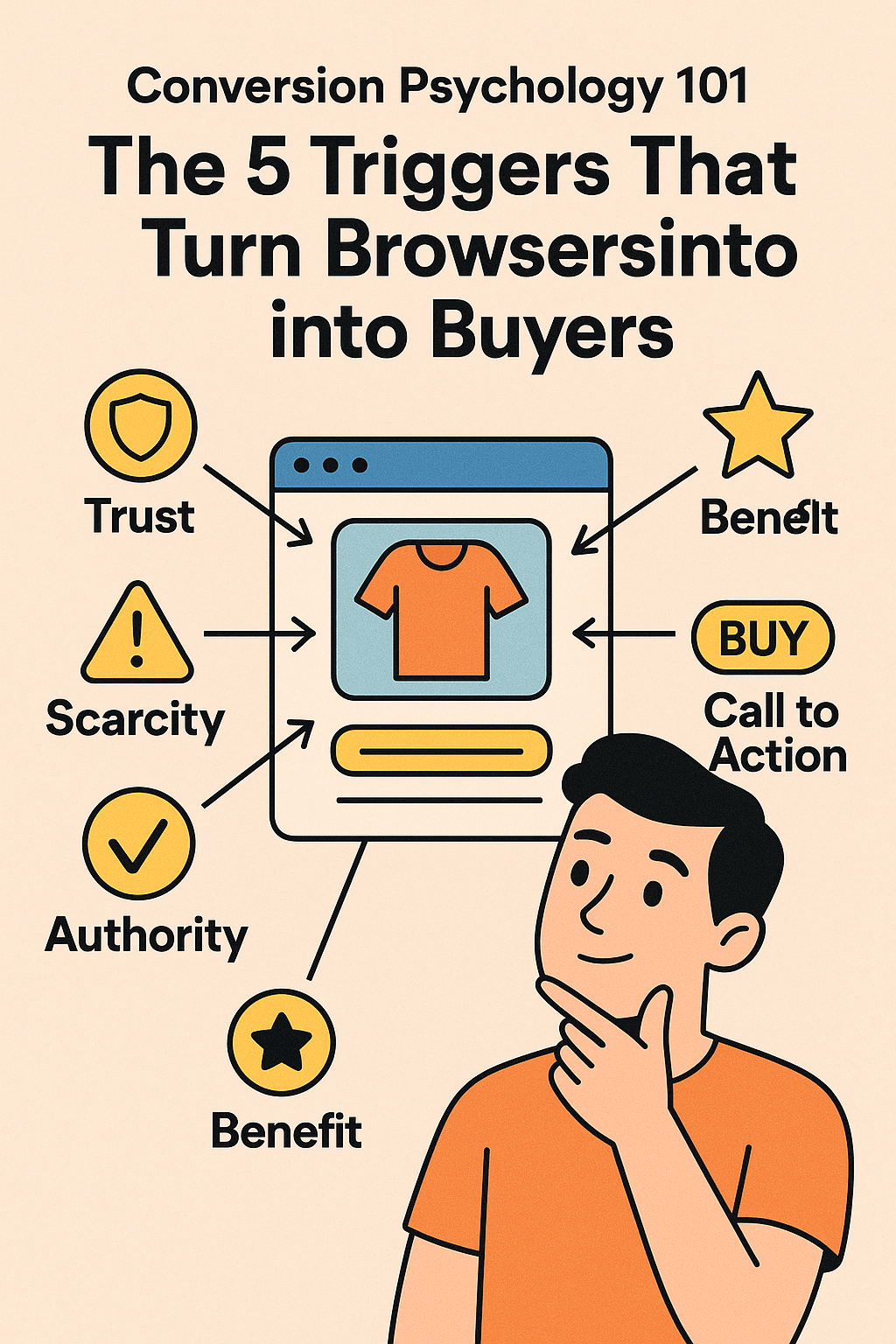
Your website has a traffic problem. But not the kind you think.
You’re getting visitors—that’s not the issue. The problem is they’re showing up, looking around, and leaving without buying anything. They’re browsing, not buying. And the difference between those two behaviors isn’t luck. It’s psychology.
Human beings are predictably irrational creatures. We like to think we make logical, well-reasoned purchasing decisions after carefully weighing all the options. In reality, we decide with emotion and justify with logic afterward.
The good news? Once you understand the psychological triggers that drive buying behavior, you can ethically incorporate them into your marketing. Let’s talk about the five that matter most for small businesses.
Trigger #1: Reciprocity (Give First, Receive Later)
Here’s a universal truth: when someone gives you something of value, you feel obligated to give something back. It’s hardwired into human social behavior, and it’s incredibly powerful in marketing.
This is why free trials work. Why lead magnets convert. Why “value-first” content marketing is actually a strategy, not just nice-guy posturing.
When you give away genuinely useful content—a detailed guide, a free tool, a helpful webinar—you’re creating a sense of reciprocity. Your prospect thinks (often unconsciously), “They helped me with this problem. I should give them my business.”
How to use it: Offer something valuable before asking for the sale. Not a 3-page PDF that says nothing. Actual value. A template that saves someone two hours. A video that solves a specific problem. A free audit that identifies real issues.
The key is that your free offer must be genuinely useful on its own. If someone uses your free resource and gets value without ever becoming a customer, that’s success—many of those people will eventually buy or refer someone who does.
What not to do: Don’t hold back the good stuff. Don’t make your free content a thinly veiled sales pitch. Don’t gate your worst content and expect reciprocity. People can tell when you’re being cheap.
Trigger #2: Scarcity (We Want What We Can’t Have)
Humans are loss-averse. We’re more motivated by the fear of missing out than by the possibility of gaining something. When something is scarce or might become unavailable, we want it more.
This is why “limited time” and “only 3 spots left” messaging works—when done honestly. Your brain shifts from “should I buy this?” to “can I still buy this?”
But here’s where most small businesses go wrong: they fake it. They permanently have “only 2 spots left” or run “24-hour sales” that happen every week. This erodes trust faster than any other marketing mistake.
How to use it: Build real scarcity into your offers. Only take 5 new clients per month (and actually stick to it). Offer bonuses that genuinely expire. Close enrollment after a specific date. Limit workshop attendance to the actual capacity of your venue.
The scarcity must be true and logical. “Only 3 consulting spots left this month because that’s all my calendar can accommodate” makes sense. “Only 3 downloads left of this digital product” does not.
What not to do: Never fake scarcity. Never use countdown timers that reset. Never claim limited availability when there isn’t any. You might get a short-term conversion boost, but you’ll destroy trust and your reputation.
Trigger #3: Social Proof (Everybody’s Doing It)
We look to others to determine what’s normal, acceptable, and valuable. When we’re uncertain, we follow the crowd. This is social proof, and it’s one of the most powerful conversion triggers in existence.
When 4,000 businesses use your software, that means something. When your service has 287 five-star reviews, that tells a story. When you have testimonials from recognizable names, it transfers credibility.
Social proof works because it reduces risk. Your prospect thinks, “All these other people tried it and it worked for them. It’ll probably work for me too.”
How to use it: Display your numbers if they’re impressive: customers served, projects completed, years in business, money saved for clients. Show testimonials from real people—names, photos, and specific results. Feature case studies that detail the problem, solution, and outcome.
The more specific your social proof, the better. “This saved me time” is weak. “I went from spending 6 hours on invoicing to 30 minutes per week” is powerful because it’s specific and measurable.
What not to do: Don’t fabricate testimonials. Don’t cherry-pick misleading stats. Don’t claim “thousands of satisfied customers” if you’ve served 43 people. Small numbers with real proof beat big numbers that feel fake.
Trigger #4: Authority (We Trust the Experts)
People defer to authority figures and experts. We’re more likely to buy from someone we perceive as knowledgeable and credible in their field.
This is why doctors can charge more than health bloggers. Why a CPA’s tax advice feels more valuable than your neighbor’s. Why credentials, certifications, and media appearances matter.
For small businesses, authority doesn’t require fame—it requires demonstrable expertise. The business owner who’s been solving this specific problem for 15 years has authority. The consultant who’s published research in their field has authority. The coach with 200 client success stories has authority.
How to use it: Showcase your credentials, but more importantly, demonstrate your expertise through your content. Write detailed blog posts that reveal deep knowledge. Create resources that only someone with real experience could produce. Share insights that go beyond surface-level advice.
Being featured in media helps—guest posts, podcast interviews, speaking engagements all build authority. Even local news mentions or industry publication features add credibility.
What not to do: Don’t overstate your qualifications. Don’t pretend to credentials you don’t have. Don’t let your authority become arrogance—expertise should make you more helpful, not more condescending.
Trigger #5: Consistency (We Honor Our Commitments)
Once people commit to something small, they’re more likely to follow through with larger commitments that align with that initial decision. This is the consistency principle, and it’s why multi-step funnels work.
When someone downloads your guide, they’ve made a micro-commitment: “I’m interested in solving this problem.” When they attend your webinar, they’re committing more time and attention. By the time you present your offer, they’ve already invested in the journey—backing out now feels inconsistent with their previous actions.
This is also why email sequences work. Each email your prospect opens and reads is a small commitment. They’re consistently showing interest. The purchase becomes the natural next step in a pattern they’ve already established.
How to use it: Design your funnel as a series of small commitments that lead to the sale. Start with something easy and low-risk—subscribing to your email list, following you on social media, downloading a free resource.
Then gradually increase the level of commitment: attending a webinar, booking a discovery call, trying a free trial. Each step should feel like the natural progression from the previous one.
What not to do: Don’t jump from “here’s a free PDF” to “buy my $5,000 program” in one step. Don’t ask for huge commitments before building any relationship. Don’t make your initial asks too demanding—if your lead magnet requires 30 minutes of work, people won’t start.
Combining Triggers for Maximum Impact
These triggers don’t work in isolation—they’re most powerful when layered together.
A testimonial (social proof) from a recognized industry expert (authority) saying they’re one of only 50 clients you work with per year (scarcity) creates a much stronger case than any single trigger alone.
Your free masterclass (reciprocity) that features specific client results (social proof) and demonstrates your methodology (authority) creates multiple psychological nudges toward conversion.
The key is to use these triggers naturally and honestly. When you’re forcing them or fabricating them, it feels manipulative because it is.
The Ethics of Conversion Psychology
Let’s address the uncomfortable question: is this manipulation?
It can be. If you’re using these triggers to trick people into buying something that doesn’t benefit them, yes, that’s manipulation. If you’re using them to ethically guide people toward a solution that genuinely helps them, that’s good marketing.
The test is simple: would you still use these techniques if your customer could see exactly what you’re doing? If the answer is no, you’re probably crossing a line.
Real scarcity isn’t manipulation—it’s honesty about your capacity. Social proof isn’t manipulation—it’s evidence of your results. Authority isn’t manipulation—it’s demonstration of expertise.
The unethical version is fake scarcity, fabricated testimonials, and inflated credentials. Don’t do that.
Measuring What Works
Not all triggers will work equally well for your business. Test them:
A/B test pages with and without social proof. Which converts better?
Try different authority signals. Do credentials matter more to your audience than case studies?
Experiment with scarcity messaging. Does time-limited or quantity-limited drive more action?
Track your data. What drives conversions for one business might fall flat for another. Your audience will tell you what resonates if you’re paying attention.
Common Mistakes That Kill Conversions
Even when using these triggers correctly, small businesses often sabotage themselves:
Mistake #1: Too Many Triggers at Once If your page simultaneously pushes scarcity, authority, social proof, and reciprocity with the subtlety of a sledgehammer, it feels desperate. Pick 1-2 primary triggers per page and let them breathe.
Mistake #2: Weak Proof “Many satisfied customers” isn’t social proof. It’s vague marketing speak. “183 roofing contractors in Texas now close 23% more jobs” is social proof—it’s specific and verifiable.
Mistake #3: Inconsistent Messaging If your authority trigger says you’re “industry-leading experts” but your website looks like it was built in 2003 and your blog has three posts, the cognitive dissonance kills trust.
Start With One Trigger
Don’t try to implement all five triggers everywhere all at once. Start with one:
Identify which trigger is most natural for your business. If you have great client results, lead with social proof. If you have impressive credentials or experience, lean into authority. If you genuinely have limited capacity, use scarcity.
Implement it thoroughly and honestly in your marketing. Measure the impact. Then layer in additional triggers strategically.
Remember: these triggers work because they tap into real human psychology. Use them to help guide people toward solutions that actually help them, and you’re not being manipulative—you’re being effective.
And that’s the difference between browsers and buyers.
 Marketing Tools HQ
Leave a comment