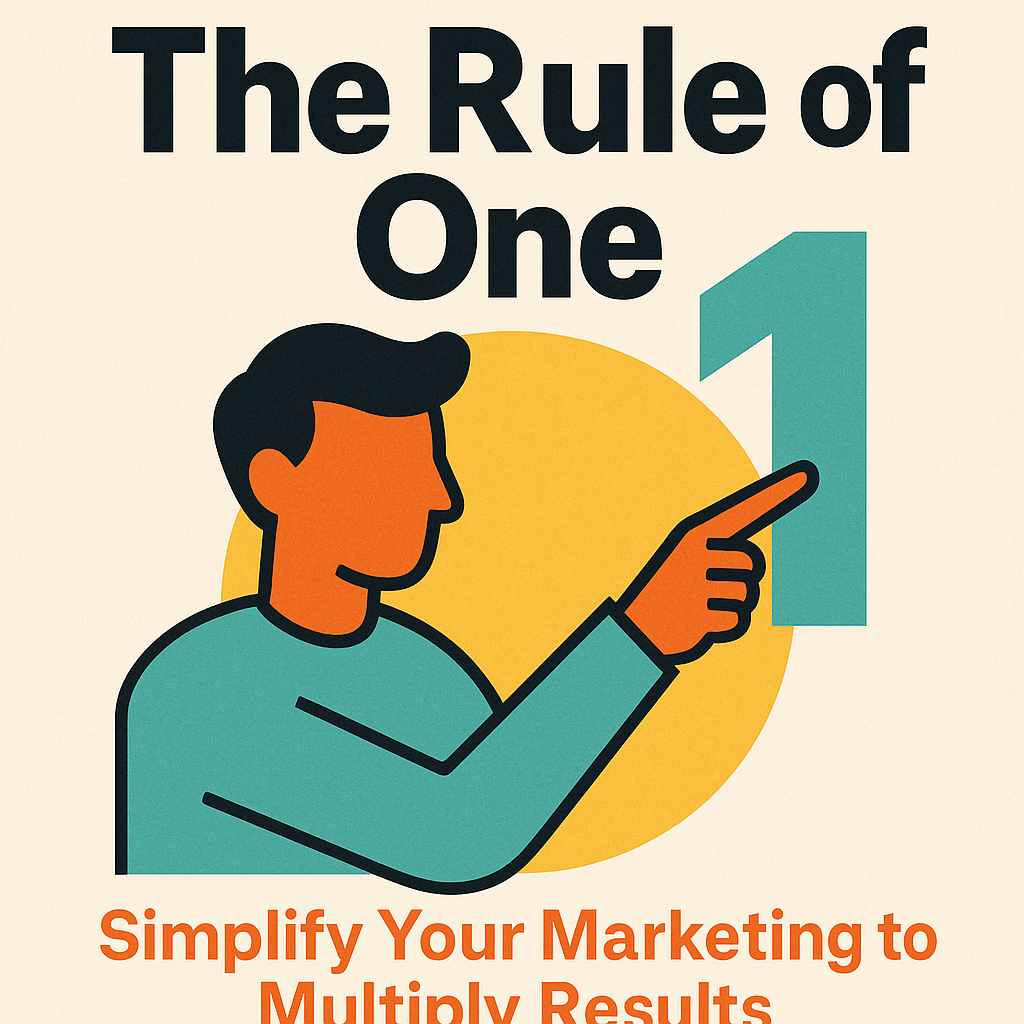
Your marketing is probably doing too much. Way too much. And it’s killing your results.
I know, I know—you offer multiple services to multiple audiences with multiple benefits. You want to communicate all of it because what if someone misses something important? What if you leave money on the table?
Here’s what actually happens: you confuse everyone, convert nobody, and wonder why your “comprehensive” marketing message lands with a thud.
The solution is almost insulting in its simplicity: the Rule of One. One message. One audience. One problem. One solution. One call-to-action. Stop trying to be everything to everyone in every piece of marketing.
What Is the Rule of One?
The Rule of One is a framework that forces you to focus each marketing message on a single element. It’s not about limiting your business—it’s about limiting each individual communication to one clear purpose.
Every email, every ad, every landing page, every social post should have:
- One core message you want to communicate
- One specific audience you’re talking to
- One main problem you’re solving
- One primary benefit you’re promising
- One clear call-to-action you want them to take
Notice I didn’t say “only one service” or “only one product.” You can offer seventeen services—just don’t try to sell all seventeen in the same marketing piece.
This isn’t about dumbing down your business. It’s about respecting the reality that confused people don’t buy. Clarity always converts better than comprehensiveness.
Why More Messages = Fewer Conversions
Let’s talk about what happens in your prospect’s brain when they encounter your marketing.
Scenario A: Your homepage says “We help small businesses with accounting, HR, legal compliance, tax planning, payroll, benefits administration, and strategic consulting.”
Your visitor thinks: “Okay, so they do… a lot? Which one do I need? Is this the right fit? Let me check another tab.”
Scenario B: Your homepage says “We handle your payroll so you never have to worry about it again.”
Your visitor thinks: “I hate dealing with payroll. Tell me more.”
Same business. Same services available. Completely different response. The second version follows the Rule of One—it speaks to one specific pain point with one specific solution.
The problem with listing everything is that you’re forcing your audience to do the work. They have to figure out which of your seventeen services matters to them, whether you’re better than competitors, and what they should do next. That’s exhausting. They’ll leave.
One Audience at a Time
You probably have multiple customer types. That’s fine. What’s not fine is trying to speak to all of them simultaneously.
A marketing message written for both enterprise clients and solopreneurs will satisfy neither. It’ll be too complex for the solopreneur and too simplistic for the enterprise buyer. You’ll water down your message trying to include everyone.
Instead, create separate campaigns for each audience. Your email to restaurant owners should read completely differently than your email to dental practices, even if you’re selling the same underlying software.
This feels inefficient until you realize that one highly targeted campaign to restaurant owners will outperform ten generic “small business” campaigns. You’re not doing more work—you’re doing smarter work.
One Problem per Campaign
Your service might solve twelve problems. Your marketing campaign should focus on one.
Why? Because your prospect isn’t experiencing all twelve problems simultaneously. Right now, in this moment, they’re feeling the pain of one specific issue. If your marketing addresses that issue clearly and specifically, they’ll pay attention. If it’s buried in a list of twelve problems, they’ll miss it.
Different campaigns can address different problems. Your summer campaign might focus on “drowning in tax paperwork during your busy season.” Your winter campaign might focus on “preparing for year-end bookkeeping chaos.” Same service, different pain points, different campaigns.
This also makes your marketing easier to test and optimize. When one campaign outperforms another, you know exactly which problem resonates most strongly with your audience.
One Benefit That Actually Matters
Here’s where most businesses go wrong: they list features and benefits like they’re writing a product manual.
“Our software includes automated reporting, cloud-based access, real-time syncing, mobile apps, integrations with 47 platforms, customizable dashboards, and…”
Stop. Nobody cares about your feature list. They care about the one benefit that solves their biggest problem.
“See exactly where your money’s going without spending hours in spreadsheets.”
That’s one benefit. It’s specific. It’s outcome-focused. It addresses a real pain point. Everything else is secondary information that comes later, after you’ve hooked their interest.
Your feature list belongs on your features page (which people visit after they’re already interested). Your marketing message belongs wherever people first encounter you, and it needs to lead with the one benefit that makes them think “I need that.”
One Call-to-Action (And Only One)
This is where small businesses especially tend to panic. “But what if they want to book a call? Or download our guide? Or sign up for our newsletter? Or check out our services page? We should give them options!”
No. You should give them one clear next step.
Every decision point you add decreases the likelihood of any action being taken. It’s called decision paralysis, and it’s real. When faced with multiple options, people often choose none.
Your landing page should have one CTA: “Schedule Your Free Consultation.” Not “Schedule a call OR download our guide OR browse services OR watch a demo.” Just one action. Everything else is distraction.
If you absolutely must offer alternatives, make one primary (big, colorful, prominent) and others secondary (smaller, less prominent, clearly subordinate). But ideally? Just one.
How to Apply the Rule of One
Let’s get practical about implementing this in your actual marketing:
Email Campaigns: Each email should have one purpose. If you’re promoting a webinar, that’s the only CTA. Don’t also mention your new blog post and upcoming sale in the same email. Send separate emails.
Landing Pages: One landing page, one offer, one audience, one problem, one solution, one CTA. If you’re targeting both restaurants and retail stores, create two landing pages with tailored messaging for each.
Social Media Posts: Each post should make one point or serve one purpose. Not “Here are 7 things we learned this week.” Instead, make seven separate posts that dive deep into one thing.
Ad Campaigns: Run separate ad campaigns for each audience segment or problem you’re addressing. Don’t try to appeal to everyone in one ad. Facebook and Google’s targeting exists for a reason—use it.
The Exceptions (There Aren’t Many)
“But what about my About page? My services page? My homepage?”
Your homepage gets a slight exception because it’s an overview, but even then, you should lead with your primary message before mentioning other offerings. Your services page can list multiple services, but each service should link to its own dedicated page that follows the Rule of One.
Your About page? Nobody’s reading it unless they’re already interested, so it’s not where the Rule of One matters most.
The key is distinguishing between marketing (where you’re trying to capture attention and drive action) and information architecture (where you’re organizing your full offerings for people already engaged).
Testing the Rule of One
Want to see if this actually works? Try this:
Take your current homepage or your highest-traffic landing page. Duplicate it. On the duplicate, strip it down to follow the Rule of One religiously:
- One clear headline addressing one specific pain point
- One audience (even if you serve multiple, pick your best one)
- One primary benefit
- One call-to-action
Run both versions. Compare conversion rates.
In my experience helping small businesses, the simplified version typically converts 30-70% better. Sometimes more. The comprehensive version might feel safer, but the focused version actually performs.
Why This Feels Scary (And Why You Should Do It Anyway)
I get it. Focusing on one message feels limiting. What about all your other services? What about your other audience segments? What if someone would have been interested in something else?
Here’s the reality: when you try to appeal to everyone, you appeal to no one. When you try to communicate everything, you communicate nothing clearly.
The businesses that win aren’t the ones offering the most options. They’re the ones making it crystal clear what they do and who it’s for.
You can always expand later. You can always create additional campaigns for other audiences or offerings. But right now, in this moment, focus on the one thing that will resonate most strongly with your most valuable audience.
The Compound Effect of Focus
Here’s what happens when you consistently apply the Rule of One:
Your messaging becomes clearer. Your targeting becomes sharper. Your conversion rates improve. Your cost per acquisition drops. Your marketing becomes easier to create because you’re not trying to jam everything into every piece.
You spend less time creating convoluted marketing messages and more time creating focused campaigns that actually work. You waste less money on broad campaigns that appeal to nobody and more money on targeted campaigns that convert.
Most importantly, you stop confusing your prospects. They land on your site, immediately understand what you offer and whether it’s relevant to them, and take action. Or they don’t, which is also fine—better to quickly filter out bad fits than spend time on unqualified leads.
Start With One Campaign
Don’t try to rebuild your entire marketing strategy overnight. Start with one campaign. One email. One landing page. One ad.
Apply the Rule of One ruthlessly. One audience. One problem. One solution. One benefit. One CTA.
Measure the results. Compare them to your previous “comprehensive” approach.
Then do it again with your next campaign.
Simplify to multiply. Focus to grow. One message at a time.
 Marketing Tools HQ
Leave a comment