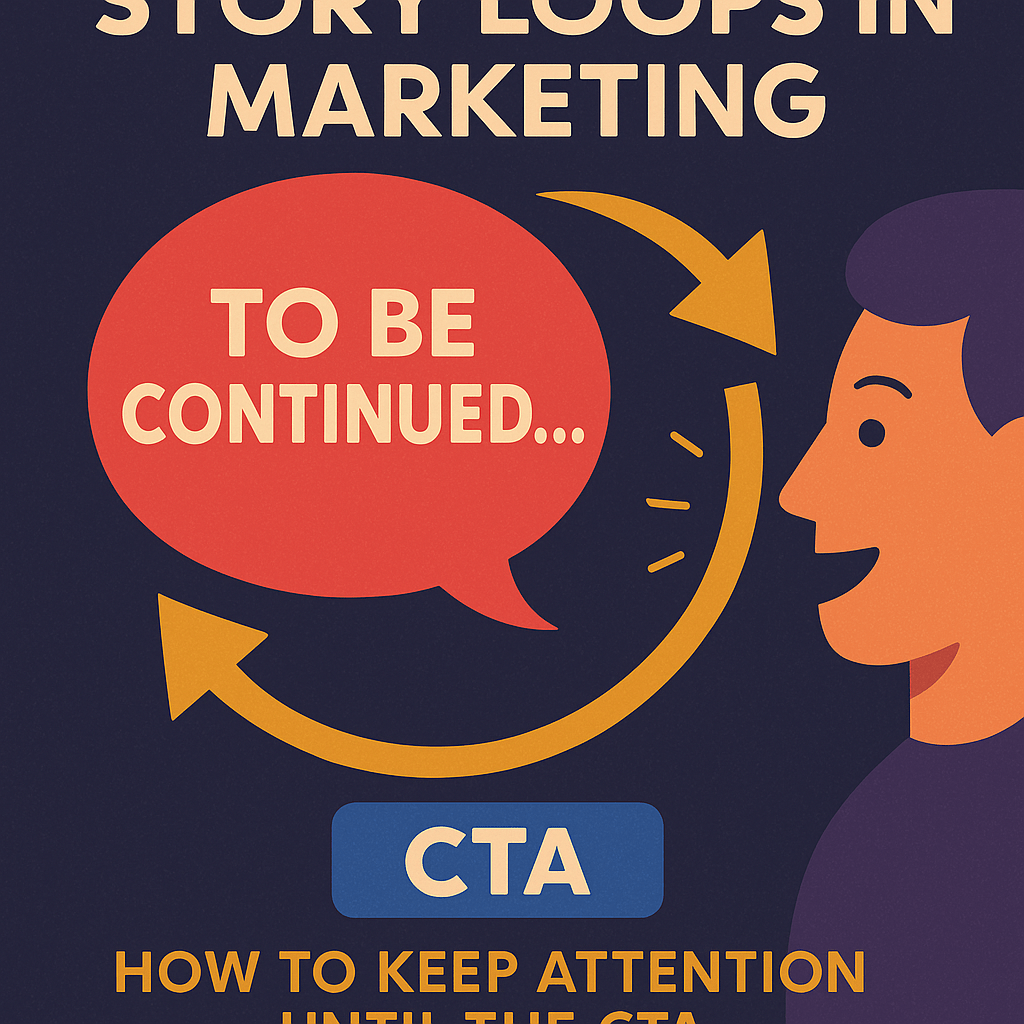
Ever notice how you’ll watch an entire episode of a mediocre TV show just because you need to know what happens next? That’s not willpower failure—that’s a story loop, and it’s been weaponized by screenwriters to keep your butt in the seat through commercial breaks.
Good news: you can use the same psychological trick in your marketing. Bad news for your competition: most of them don’t know this exists.
Story loops are the secret weapon that keeps people reading your emails, watching your videos, and scrolling through your sales pages until they finally hit that call-to-action button. Without them, you’re just another piece of content that gets abandoned halfway through.
What Is a Story Loop?
A story loop is an open question or unresolved tension that your brain desperately wants to close. It’s the marketing equivalent of saying “But wait, there’s more” except actually effective.
Think about the last clickbait headline you couldn’t resist: “I tried this weird morning routine for 30 days. What happened on day 23 will shock you.” Congratulations, you just got story-looped. Your brain now has an open question (what happened on day 23?) that it wants resolved.
The loop is opened when you create curiosity or tension. It’s closed when you provide the answer or resolution. Everything that happens between opening and closing the loop is what keeps people engaged.
In marketing, story loops prevent people from bouncing before they see your offer. They’re the difference between “meh, I’ll read this later” (narrator: they won’t) and “I need to see where this is going.”
Why Your Brain Can’t Ignore an Open Loop
There’s actual science behind why story loops work, and it’s called the Zeigarnik Effect. Fancy name, simple concept: your brain hates unfinished business.
Psychologist Bluma Zeigarnik discovered that people remember incomplete tasks better than completed ones. That unfinished project? It’s taking up mental real estate rent-free. That TV show you stopped watching mid-season? Your brain occasionally pokes you about it.
When you open a story loop in your marketing, you create a mini incomplete task in your reader’s brain. Close the tab, and that open question lingers. The only way to close it is to keep reading.
This is why “How to Increase Sales” (no loop) performs worse than “The one email mistake costing you sales (and how to fix it)” (loop opened). The second version creates an open question: What’s the mistake? Am I making it?
The Anatomy of a Marketing Story Loop
Let’s break down how to actually build these things into your marketing content.
The Hook: This is where you open the loop. You can use a question, a promise, a surprising statement, or a tease. “Most small businesses make this checkout mistake” or “I’m about to share the subject line that tripled my open rates.”
The Middle: This is where you keep the loop open while delivering value. You’re giving useful information, but you’re not answering the main question yet. You’re building context, establishing credibility, sharing related insights. The key is to reference the loop periodically so people don’t forget why they’re still reading.
The Payoff: This is where you close the loop and deliver on your promise. “Here’s the mistake: you’re asking for too much information.” “The subject line was: [Your Name] – Quick Question.” You must deliver what you promised, or people will feel manipulated and won’t trust you again.
The New Loop (Optional): Sometimes you close one loop and immediately open another. TV shows do this constantly—they resolve this episode’s tension while setting up next week’s cliffhanger. In marketing, this might be closing the loop on one benefit while teasing another, or answering one question while raising a new one.
Story Loop Techniques That Actually Work
Let’s get tactical. Here are specific ways to open story loops in different marketing contexts:
Email Subject Lines:
- “The reason your landing page isn’t converting (it’s not what you think)”
- “I made this mistake for 3 years…”
- “Quick question about your website”
Notice these all create curiosity without being sleazy. You’re genuinely offering value; you’re just structuring it to encourage opens.
Email Body Content: “I’m going to share the exact template I used to book 23 client calls last month. But first, you need to understand why most cold outreach fails…”
You’ve opened the loop (the template) and now you’re delivering context before the payoff.
Video Scripts: “By the end of this video, you’ll know the three-word phrase that makes customers trust you instantly. First, let me show you why most trust-building advice backfires…”
Sales Pages: “There’s a reason why 73% of visitors abandon shopping carts. In the next two minutes, you’ll discover what it is and how our solution prevents it.”
Common Story Loop Mistakes to Avoid
Before you go loop-crazy, let’s talk about how not to do this:
Mistake #1: Opening Loops You Never Close
This is clickbait, and people hate it. If your headline promises “the one weird trick” and your content never delivers it, you’ve burned trust. Close every loop you open.
Mistake #2: Taking Too Long to Close the Loop
If someone has to read 2,000 words before you answer the question from your headline, they’re gone. Open loops create tension—but too much tension for too long becomes frustration.
Mistake #3: Making the Payoff Disappointing
“The secret to doubling your sales? Work harder and be better.” Nobody drove all the way to the punchline for that generic advice. Your payoff needs to be worth the journey.
Mistake #4: Using Too Many Loops Simultaneously
Opening twelve different loops in one piece of content doesn’t make it twelve times more engaging—it makes it confusing. Focus on one or two primary loops per piece.
Story Loops in Different Marketing Channels
Different platforms require different approaches:
Email Marketing: Your subject line opens a loop. Your first paragraph reinforces it. Your body content delivers context. Your CTA either closes the loop or bridges to another loop (like a landing page).
Social Media Posts: Short-form content means quick loops. Open a loop in the first sentence, deliver the payoff in the caption, and include a CTA to a longer loop (blog post, video, etc.).
Landing Pages: Your headline opens the loop. Your subheadline adds context. Your body copy builds tension while providing value. Your CTA is positioned right before or as you close the loop—when engagement is highest.
Video Content: Open multiple small loops throughout to maintain attention. “Coming up next, I’ll show you…” keeps people watching through the current segment.
The Loop-CTA Relationship
Here’s where this gets strategic: the best time to present your call-to-action is right when you’re closing a major loop or right before.
Why? Because that’s when attention is highest. Your reader just invested time and mental energy following your loop. They’re engaged. They want the resolution. This is when they’re most receptive to your offer.
Example structure:
- Open loop in headline: “The checkout process killing your conversions”
- Build context and value in body copy
- Present the problem clearly (still maintaining tension)
- Position your solution as the loop closer: “Our one-click checkout solves this exact problem”
- CTA: “See how it works”
You’re not just closing the loop—you’re making your product or service the answer to the question you raised.
Testing Your Story Loops
Not sure if your story loops are working? Here’s how to tell:
Attention Metrics: Are people reading to the end? Track scroll depth on web pages, read-through rates on emails, watch time on videos. If people bail halfway through, your loop isn’t strong enough or your content isn’t delivering enough value along the way.
Engagement Metrics: Are people clicking your CTAs? If they’re reading but not acting, your loop might be closing too early (before the CTA) or your offer isn’t positioned as the logical next step.
A/B Testing: Test content with loops against content without them. Compare headlines that open loops versus straightforward headlines. The data will tell you what works for your audience.
The Ethics of Story Loops
Let’s address the elephant in the room: is this manipulation?
Only if you’re using it to deceive. Story loops are a framework for structuring information in an engaging way. They’re manipulative when you promise something you don’t deliver or when you create false urgency.
Used ethically, story loops respect your audience’s time by making your content more engaging and easier to consume. They help you guide readers to information that genuinely helps them.
The rule is simple: always deliver on your promise. If you open a loop about “the biggest marketing mistake,” you better reveal an actual meaningful mistake, not some generic platitude.
Start Opening (and Closing) Loops
Story loops aren’t some dark magic trick—they’re just smart content structure. They acknowledge that attention is scarce and earning it requires more than dumping information on a page.
Your next email: start with a question or promise. Your next social post: tease the payoff before delivering it. Your next landing page: structure your copy around resolving tension rather than listing features.
And always, always close the loops you open. Your audience’s attention is a gift. Don’t waste it.
 Marketing Tools HQ
Leave a comment