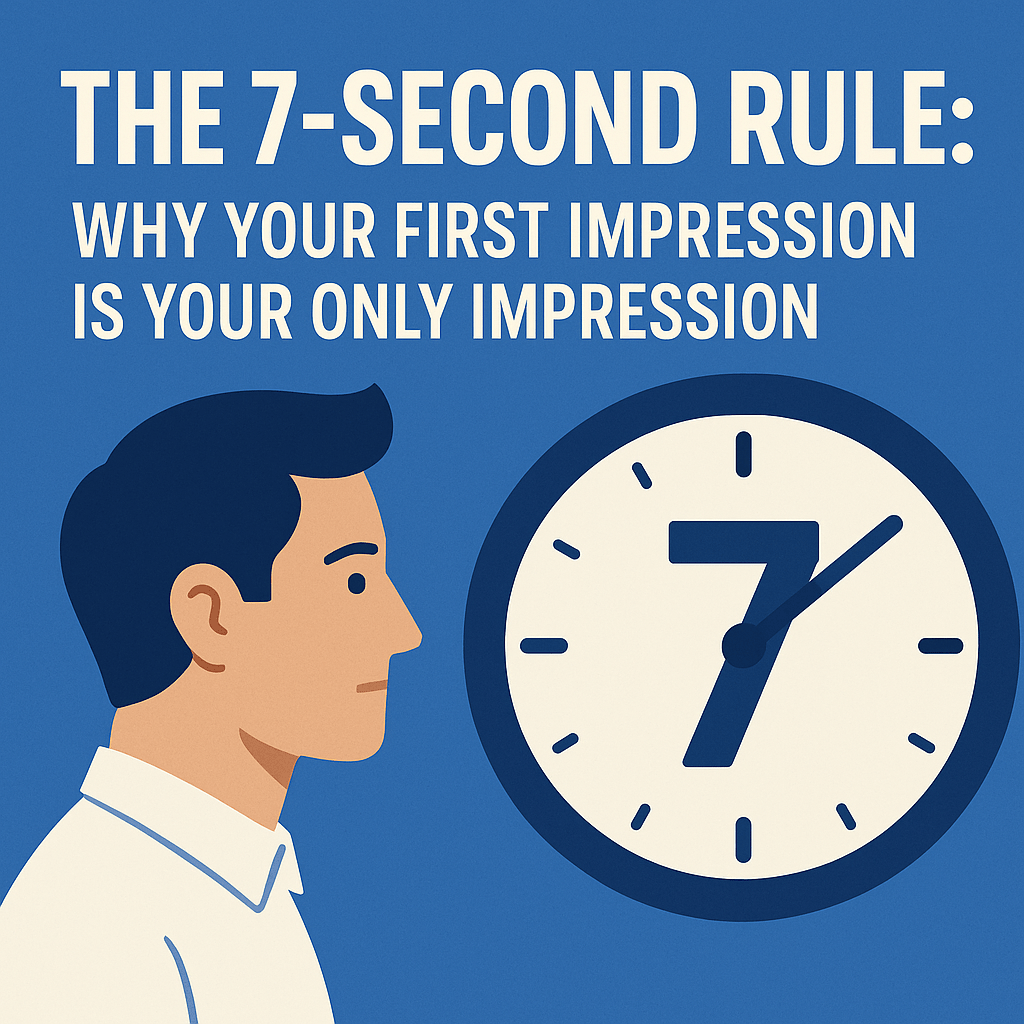
Your brain makes snap judgments faster than you can say “nice to meet you.” Neuroscience research reveals that people form lasting impressions in just seven seconds—before you’ve finished your second sentence. Whether you’re introducing yourself at a networking event, starting a presentation, or writing a cold email, those first seven seconds determine everything that follows.
Here’s what’s happening in your audience’s brain during those critical moments: They’re simultaneously assessing your credibility, likability, and relevance. Miss on any of these three factors, and you’ve lost them before you’ve truly begun. The good news? You can engineer first impressions that work in your favor every single time.
The Neuroscience Behind First Impressions
When someone encounters you for the first time, their amygdala—the brain’s threat detection center—activates immediately. This ancient survival mechanism asks three questions: “Can I trust this person? Do they understand me? Is this worth my attention?”
Your audience isn’t consciously thinking these thoughts, but their brain is making these calculations at lightning speed. Visual cues, vocal tone, body language, word choice, and even the structure of your opening statement all feed into this rapid assessment process.
Studies from Princeton University show that people form judgments about competence, trustworthiness, and likeability in as little as one-tenth of a second when viewing faces. When speaking or writing, you have slightly more time—but not much. Seven seconds is generous.
The Clarity → Credibility → Curiosity Framework
The most effective communicators structure their introductions using this three-part formula:
Clarity First (Seconds 1-2): State exactly who you are or what you’re discussing in plain language. “I help small businesses double their email conversion rates” beats “I’m a digital marketing optimization specialist focused on engagement metrics.” Confusion kills credibility instantly.
Credibility Second (Seconds 3-5): Quickly establish why you’re worth listening to without bragging. “I’ve helped 47 companies in the last two years” or “This approach generated $2M for our clients” provides social proof without lengthy credentials. One strong proof point is enough—more than that and you lose momentum.
Curiosity Last (Seconds 6-7): End with something that makes them want to hear more. Ask a provocative question, present a surprising statistic, or tease a valuable insight. “Want to know the one email change that tripled our response rates?” creates an open loop their brain needs to close.
Practical Application
For spoken introductions: “I’m Sarah, and I help nonprofits raise more money with less effort. Last year, my clients raised an additional $8M using strategies that took them under 10 hours to implement. Most of them started by fixing one thing they didn’t even know was broken—want to guess what it was?”
For written introductions: Your email subject line plus first sentence combine to create your seven-second window. “Re: Your Website Conversion Rate” as a subject line, followed by “I noticed your homepage gets 50,000 visits monthly but only generates 30 leads” creates immediate clarity and credibility while naturally prompting curiosity about the solution.
For social media: Your profile photo, bio, and pinned post work together as your seven-second introduction to new visitors. Each element must pass the clarity, credibility, and curiosity test.
The Bottom Line
You don’t get a second chance to make a first impression, but you do get to engineer that first impression deliberately. Structure every introduction—whether spoken, written, or visual—around clarity, credibility, and curiosity. Your audience’s ancient brain is making snap judgments whether you plan for it or not. The only question is whether you’ll control those judgments or leave them to chance.
Start with absolute clarity about what you do or what you’re discussing. Establish credibility quickly with one strong proof point. End with curiosity that pulls them forward. Master this sequence, and you’ll win more of those critical seven-second decisions that determine your success.
 Marketing Tools HQ
Leave a comment