The SaaS marketing landscape has transformed dramatically over the past five years, and so has the technology powering it. What once required a patchwork of disconnected tools now demands an integrated, intelligent marketing stack capable of tracking the entire customer journey—from anonymous visitor to expansion revenue.
If you’re a marketing leader at a growth-stage B2B SaaS company, you’re facing a critical question: which tools actually move the needle, and which are just adding to your tech debt?
This comprehensive guide breaks down the 2025 SaaS marketing stack layer by layer, helping you make informed decisions about where to invest your budget and where to consolidate.
Executive Summary: How the SaaS Marketing Stack Has Evolved
The past 3-5 years have fundamentally reshaped how B2B SaaS companies approach marketing technology. Here are the seismic shifts:
Product-Led Growth (PLG) Has Changed Everything. The traditional MQL-to-SQL funnel has been supplemented (and in many cases replaced) by product-qualified leads (PQLs). Marketing teams now need tools that integrate deeply with product analytics, tracking in-app behavior alongside marketing touchpoints. Companies like Slack, Figma, and Notion proved that the product itself is the most powerful marketing channel.
AI Has Moved from Novelty to Necessity. Early AI tools were experimental; by 2025, AI-powered capabilities are table stakes. From content generation and optimization to predictive lead scoring and personalized email sequences, teams expect their tools to leverage machine learning. The difference now is that AI is embedded throughout the stack rather than existing as standalone point solutions.
Attribution Got More Complex (and More Critical). As buying committees grew larger and customer journeys became more fragmented across channels, simple last-touch attribution became obsolete. Modern teams demand multi-touch attribution models that account for dark social, community influence, and the reality that B2B buyers conduct extensive research before ever filling out a form.
Consolidation Over Point Solutions. The era of “best-of-breed everything” is giving way to strategic consolidation. Marketing leaders are tired of managing 30+ integrations and reconciling conflicting data across platforms. The winners in 2025 are platforms that do 80% of multiple jobs excellently, even if they’re not the absolute best at any single function.
Real-Time Data Infrastructure. Batch processing and daily syncs are no longer acceptable. Modern marketing stacks are built on event streaming and reverse ETL architectures that enable real-time personalization, instant lead routing, and up-to-the-minute reporting.
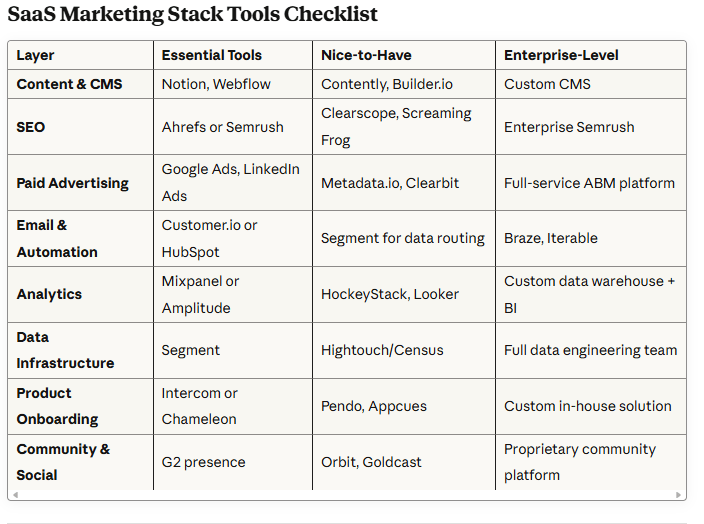
With that context, let’s dive into the eight critical layers of the modern SaaS marketing stack.
Layer 1: Content Creation & Management
At the heart of any SaaS marketing strategy is content—blogs, guides, videos, and interactive assets that educate prospects and drive organic traffic.
Top Tools
1. Notion (with AI)
- Best For: Small to mid-size teams (10-50 people) who want an all-in-one workspace
- Price Tier: $8-15/user/month
- Pros: Unified workspace for content planning, creation, and collaboration; AI writing assistant; unlimited flexibility in structuring workflows
- Cons: Can become messy without strong information architecture; not purpose-built for content marketing; limited SEO functionality
- Sweet Spot: Teams under 30 people who value flexibility over specialized features
2. Contently or Jasper AI
- Best For: Content-heavy strategies requiring scale and workflow management
- Price Tier: $500-2,000+/month depending on scale
- Pros: Purpose-built for content marketing; freelancer management (Contently); AI generation at scale (Jasper); content performance analytics
- Cons: Expensive for smaller teams; AI outputs require significant editing; learning curve
- Sweet Spot: Companies producing 20+ content assets monthly with distributed teams
3. Webflow + Builder.io
- Best For: Marketing teams who want design freedom without engineering dependencies
- Price Tier: $29-212/month (Webflow) + $50-500/month (Builder.io)
- Pros: No-code website building; fast page load times; CMS flexibility; A/B testing built-in
- Cons: Steeper learning curve than WordPress; requires designer mindset; limited CRM integration
- Sweet Spot: Design-forward companies that treat their website as a primary conversion tool
Layer 2: SEO & Keyword Intelligence
Organic search remains the highest-ROI channel for most B2B SaaS companies, making SEO tools non-negotiable.
Top Tools
1. Ahrefs
- Best For: Comprehensive SEO strategy and competitive intelligence
- Price Tier: $129-999/month
- Pros: Best-in-class backlink database; content gap analysis; accurate keyword difficulty metrics; excellent UI
- Cons: Expensive for startups; can be overwhelming for beginners; limited integration with other tools
- Sweet Spot: Companies with dedicated SEO resources and budgets over $50K/year for content
2. Clearscope or Surfer SEO
- Best For: Content optimization and on-page SEO
- Price Tier: $170-1,200+/month
- Pros: AI-powered content briefs; real-time optimization scores; SERP analysis; easy for writers to use
- Cons: Requires existing content strategy; doesn’t replace comprehensive SEO tools; can encourage keyword stuffing if misused
- Sweet Spot: Teams producing 10+ SEO-focused articles monthly
3. Semrush
- Best For: All-in-one SEO, content, and competitor research
- Price Tier: $139-499/month (custom pricing for larger teams)
- Pros: Incredibly comprehensive feature set; strong competitor analysis; content marketing toolkit; paid ad research
- Cons: Overwhelming number of features; data accuracy slightly behind Ahrefs for backlinks; steeper learning curve
- Sweet Spot: Mid-market companies wanting one platform for SEO, content, and competitive intelligence
Layer 3: Paid Advertising & Demand Generation
While organic is critical, paid channels accelerate growth and test messaging quickly.
Top Tools
1. Metadata.io or Madgicx
- Best For: Cross-channel paid campaign automation
- Price Tier: $500-5,000+/month based on ad spend
- Pros: AI-powered budget allocation across channels; automatic A/B testing; unified reporting; significant time savings
- Cons: High entry cost; black box optimization can limit learning; requires significant ad spend to justify
- Sweet Spot: Companies spending $50K+/month across Google, LinkedIn, and Meta
2. LinkedIn Campaign Manager + Clearbit (for ABM)
- Best For: Account-based marketing and enterprise sales cycles
- Price Tier: Variable ad spend + $15K-30K/year (Clearbit)
- Pros: Unmatched B2B targeting; Clearbit enrichment for account scoring; direct integration with CRM
- Cons: High CPCs ($8-15+); ad fatigue happens quickly; limited creative formats
- Sweet Spot: Enterprise-focused SaaS with ACV over $15K
3. Google Ads + Optmyzr
- Best For: Intent-based search advertising
- Price Tier: Variable ad spend + $249-999/month (Optmyzr)
- Pros: Capture high-intent searches; strong conversion rates; Optmyzr automation saves hours weekly
- Cons: Increasingly competitive and expensive; requires continuous optimization; quality score management is time-intensive
- Sweet Spot: SaaS companies with clear search intent keywords and mature content hubs
Layer 4: Email Marketing & Marketing Automation
Email remains the highest-ROI channel for nurturing leads and driving product adoption.
Top Tools
1. HubSpot Marketing Hub
- Best For: All-in-one marketing automation with CRM included
- Price Tier: $800-3,200+/month
- Pros: Unified platform for email, landing pages, forms, and CRM; extensive integration marketplace; strong reporting
- Cons: Can get expensive quickly with contact growth; some features feel dated; vendor lock-in concerns
- Sweet Spot: Companies wanting minimal vendor management and tight sales-marketing alignment
2. Customer.io
- Best For: Product-led growth companies needing behavior-based messaging
- Price Tier: $150-1,500+/month based on profiles
- Pros: Real-time behavioral triggers; excellent segmentation; SMS, push, and in-app messages; developer-friendly
- Cons: Steeper learning curve; requires technical setup; email design tools are basic
- Sweet Spot: PLG SaaS companies where product usage drives marketing messages
3. Braze or Iterable
- Best For: Enterprise-scale personalization across channels
- Price Tier: Custom pricing, typically $30K-100K+/year
- Pros: Sophisticated cross-channel orchestration; AI-powered send-time optimization; scalable to millions of users
- Cons: Complex setup requiring data engineering; expensive; overkill for most growth-stage companies
- Sweet Spot: B2C SaaS or high-volume B2B products with complex user journeys
Layer 5: Analytics & Attribution
You can’t optimize what you can’t measure. Modern analytics stacks go far beyond Google Analytics.
Top Tools
1. Amplitude or Mixpanel
- Best For: Product analytics and user behavior tracking
- Price Tier: Free tier available; $50-2,000+/month based on volume
- Pros: Event-based tracking; cohort analysis; funnel visualization; integrates marketing and product data
- Cons: Requires instrumentation strategy; learning curve for non-technical marketers; can get expensive at scale
- Sweet Spot: PLG companies needing to understand product-qualified leads
2. HockeyStack or Dreamdata
- Best For: B2B marketing attribution and journey tracking
- Price Tier: $500-3,000+/month
- Pros: Multi-touch attribution models; account-level journey mapping; marketing-sales alignment; integrates ad spend data
- Cons: Requires clean CRM data to be effective; newer players with evolving features
- Sweet Spot: B2B SaaS with sales cycles over 30 days and multiple touchpoints
3. Looker or Metabase (with a data warehouse)
- Best For: Custom analytics and business intelligence
- Price Tier: $500-5,000+/month (Looker) or self-hosted (Metabase)
- Pros: Complete flexibility in data modeling; combines data from all sources; shareable dashboards
- Cons: Requires data engineering resources; significant setup time; not purpose-built for marketing
- Sweet Spot: Data-mature companies with engineering support and complex reporting needs
Layer 6: Customer Data Platform (CDP) & Data Infrastructure
The backbone of a modern marketing stack is clean, accessible, real-time data.
Top Tools
1. Segment
- Best For: Customer data collection and routing
- Price Tier: Free for <1,000 visitors/month; $120-1,000+/month based on volume
- Pros: Single API for all tracking; routes data to 300+ tools; maintains data quality; reduces engineering burden
- Cons: Can get expensive at scale; requires thoughtful event taxonomy; doesn’t include analytics
- Sweet Spot: Growth-stage companies integrating 5+ marketing/product tools
2. Hightouch or Census (Reverse ETL)
- Best For: Syncing warehouse data to operational tools
- Price Tier: $500-3,000+/month
- Pros: Data warehouse becomes single source of truth; real-time syncs to marketing tools; no-code model building
- Cons: Requires existing data warehouse; setup complexity; relatively new category
- Sweet Spot: Data-mature companies with Snowflake/BigQuery and engineering support
3. RudderStack
- Best For: Open-source customer data pipeline
- Price Tier: Free self-hosted; $500+/month for cloud
- Pros: No vendor lock-in; complete data control; built for developers; cost-effective at scale
- Cons: Requires engineering resources; fewer pre-built integrations than Segment; smaller community
- Sweet Spot: Technical teams wanting control and cost predictability
Layer 7: User Onboarding & Product-Led Growth
For PLG companies, the product is the primary marketing channel. Onboarding tools drive activation and expansion.
Top Tools
1. Pendo or Appcues
- Best For: In-app guides and product analytics
- Price Tier: $7,000-50,000+/year based on MAU
- Pros: No-code onboarding flows; product analytics included; multi-platform support; NPS surveys
- Cons: Expensive for early-stage; can feel intrusive if overused; requires product manager involvement
- Sweet Spot: Product-led companies with 10K+ MAU needing to improve activation
2. Intercom or Drift
- Best For: Conversational support and bot-driven qualification
- Price Tier: $74-999+/month based on contacts
- Pros: Live chat + chatbot automation; qualifies leads in real-time; knowledge base integration; SMS capability
- Cons: Can replace human touch prematurely; requires thoughtful bot design; pricing scales quickly
- Sweet Spot: Mid-market SaaS wanting to convert website traffic into conversations
3. Chameleon
- Best For: Lightweight product tours and announcements
- Price Tier: $279-1,000+/month
- Pros: Specifically focused on product tours; intuitive builder; excellent segmentation; doesn’t require engineering
- Cons: Limited analytics compared to Pendo; fewer features overall; not a full product analytics solution
- Sweet Spot: Smaller PLG companies (under 5K MAU) wanting quick wins on activation
Layer 8: Community & Social Proof
Modern B2B buyers trust peer recommendations more than any marketing message. Community tools are now essential infrastructure.
Top Tools
1. Orbit or Common Room
- Best For: Community management and member intelligence
- Price Tier: $500-2,000+/month
- Pros: Unified view of community member activity; identifies advocates; integrates Slack, Discord, GitHub; engagement scoring
- Cons: Requires active community to justify cost; doesn’t build community, just tracks it; newer tooling
- Sweet Spot: Developer-focused or open-source SaaS with active communities
2. G2 + Review Management
- Best For: Capturing and leveraging customer reviews
- Price Tier: $1,000-10,000+/year for seller tools
- Pros: Massive buyer intent signal; SEO benefits; social proof for website; competitive intelligence
- Cons: Expensive to compete in crowded categories; review solicitation requires process; gaming concerns
- Sweet Spot: B2B SaaS in competitive categories with happy customers willing to review
3. Goldcast or Demio
- Best For: Webinar hosting and virtual events
- Price Tier: $99-999+/month
- Pros: Purpose-built for marketing teams; excellent engagement features; automated follow-up sequences; recording management
- Cons: Yet another tool to manage; requires content strategy; engagement rates declining industry-wide
- Sweet Spot: Teams running 4+ webinars monthly as a demand generation channel
How to Pick the Right Tools for Your SaaS Marketing Stack
Choosing marketing tools isn’t about selecting “the best” tool in each category—it’s about building a stack that fits your specific business context. Here’s how to make smart decisions:
1. Start with Your Growth Stage
Early Stage (Pre-PMF, <$1M ARR): Prioritize flexibility and low cost. Use free tiers aggressively. Notion + Google Analytics + Mailchimp might be enough. Don’t over-invest in attribution when you’re still figuring out messaging.
Growth Stage ($1-10M ARR): This is when you build your foundational stack. Invest in proper analytics (Mixpanel/Amplitude), a real CDP (Segment), and marketing automation that scales (HubSpot or Customer.io). You’re optimizing for learning velocity.
Scale Stage ($10M+ ARR): Consolidate where it makes sense, but don’t be afraid of best-of-breed for critical functions. Invest heavily in attribution and data infrastructure. You need systems that support a 20+ person marketing team and complex go-to-market motions.
2. Align with Your GTM Motion
Product-Led Growth: Prioritize product analytics (Amplitude), in-app messaging (Customer.io, Chameleon), and onboarding optimization (Appcues). Your stack should blur the line between product and marketing.
Sales-Led with Long Cycles: Invest in attribution (Dreamdata), intent data (Clearbit, 6sense), account-based tools, and sales-marketing alignment platforms (HubSpot, Salesforce + Pardot).
Hybrid/Community-Led: Add community intelligence (Orbit), conversation platforms (Discourse, Circle), and social proof aggregation (G2, Trustpilot).
3. Calculate True Cost of Ownership
Look beyond the sticker price:
- Implementation time: Will this require engineering resources for 40+ hours?
- Learning curve: How long until the team is productive?
- Integration maintenance: Who manages the Zapier workflows when they break?
- Data cleanliness: Does this tool require pristine CRM data to function?
- Vendor switching costs: How locked-in will you be after 12 months?
A $300/month tool that requires 10 hours of admin per week costs more than a $2,000/month platform that runs itself.
4. Prioritize Integration Depth Over Breadth
It’s better to have five tools that share data seamlessly than fifteen tools with surface-level integrations. Evaluate:
- Real-time vs. batch syncing: Can you trigger workflows instantly, or is there a 24-hour delay?
- Bidirectional data flow: Does data only flow one direction, creating siloes?
- API quality: Is there comprehensive documentation and support?
- Native integrations: Are you relying on Zapier to hold critical workflows together?
5. Build for Your Data Strategy
Your martech stack should support your data philosophy:
Centralized (Data Warehouse First): Invest in Segment/RudderStack to pipe everything to Snowflake/BigQuery, then use reverse ETL (Hightouch/Census) to push data back to operational tools. Requires engineering support but provides ultimate flexibility.
Federated (Best-of-Breed): Accept that data lives in multiple places. Use tools with strong native integrations and a platform like HubSpot as a partial system of record. Lower engineering burden but more complex reporting.
Platform-Centric: Go all-in on HubSpot or Salesforce and use their ecosystems. Least flexible but easiest to maintain with small teams.
6. Team Size and Skill Mix
Small team (1-5 marketers): Prioritize all-in-one platforms and tools with excellent UI/UX. Avoid anything requiring significant technical setup.
Medium team (5-15 marketers): Can support 8-12 specialized tools. Should have at least one marketing ops person managing the stack.
Large team (15+ marketers): Justify best-of-breed tools and custom data infrastructure. Needs dedicated marketing operations team (2-4 people).
Future Trends to Watch
The marketing stack will continue evolving rapidly. Here’s what forward-thinking teams are already experimenting with:
AI-Driven Hyper-Personalization
We’re moving beyond “Hi {First_Name}” tokenization to true 1:1 personalization. Emerging AI tools will dynamically generate landing page copy, email content, and even product demos tailored to each visitor’s industry, role, and behavioral patterns. Companies like Mutiny and Dynamic Yield are pioneering this space, but expect personalization capabilities to become embedded in every marketing tool within two years.
The key unlock: real-time synthesis of product usage data, intent signals, and CRM context to deliver genuinely relevant experiences at scale.
Unified Product + Marketing Analytics
The wall between “marketing analytics” and “product analytics” is crumbling. Future platforms will seamlessly track the entire journey from anonymous visitor to power user, attributing expansion revenue back to the blog post they read six months earlier. Expect platforms like Amplitude and Mixpanel to add more marketing features, while attribution tools like HockeyStack expand into product analytics.
The best teams in 2026 will have a single source of truth for the entire customer lifecycle.
Micro-Communities as a Growth Channel
Large, general communities are giving way to small, focused cohorts. Think “VP of Marketing at $10-30M ARR logistics SaaS” rather than “SaaS marketers.” Tools like Slack Connect, Circle, and even WhatsApp Business are enabling these intimate, high-signal communities. The marketing stack will need native community intelligence—identifying advocates, tracking dark social influence, and measuring community-led pipeline.
B2B SaaS companies that crack community-led growth will have an unfair advantage in crowded markets.
Short-Form Video Finally Comes to B2B
TikTok and Instagram Reels have trained consumers to expect snackable video content. B2B SaaS is (finally) following suit. The marketing stack will need tools for:
- Rapid video creation and editing (Descript, Riverside.fm)
- Video hosting optimized for conversion (Wistia, Vidyard)
- Video analytics tied to pipeline (Vidyard, HubSpot Video)
The teams winning with video in 2025 are treating it like blog posts—publishing 3-5x per week, iterating based on engagement, and repurposing ruthlessly.
Privacy-First Attribution Models
Third-party cookies are dead. Device IDs are restricted. The future of attribution is first-party data and probabilistic modeling. Marketing stacks will increasingly rely on:
- Server-side tracking (Segment, RudderStack)
- Identity resolution across sessions (Clearbit, Koala)
- Modeled attribution using machine learning (Google Analytics 4, HockeyStack)
Teams that build clean first-party data practices now will have an enormous advantage.
Composable CDPs and the Modern Data Stack
The monolithic CDP is being replaced by composable architecture: data warehouse + reverse ETL + activation tools. This trend, driven by Snowflake, Hightouch, and dbt, gives marketing teams the flexibility of best-of-breed tools with the data consistency of a single platform.
By 2026, most sophisticated marketing teams will treat their data warehouse as their CDP.
Taking Action: Build Your Stack Strategically
The right marketing stack isn’t about having every cutting-edge tool—it’s about having the right tools that work together seamlessly and support your specific growth motion.
Start with these principles:
- Audit ruthlessly. Most teams are paying for tools no one uses. Run a utilization audit quarterly.
- Integrate deeply. Five tools with real-time, bidirectional integrations beat fifteen tools with surface-level connections.
- Invest in data infrastructure early. Clean, accessible data is the foundation. Skimp here and you’ll pay for it in every tool you add.
- Match your growth stage. Don’t build an enterprise stack when you’re pre-PMF. Don’t limp along on free tools when you’re doing $10M ARR.
- Consolidate strategically. The pendulum is swinging from “best of breed everything” to “platforms that do most things well.”
- Budget for Marketing Ops. Tools don’t manage themselves. Plan for at least one dedicated marketing ops person by the time you hit 5-7 marketers.
Your next steps:
- Download our free SaaS Marketing Stack Audit Template to evaluate your current tools against these benchmarks: Download Here
- Join 15,000+ SaaS marketing leaders who get our weekly breakdown of new tools, strategies, and benchmarks: Subscribe to Marketing Tools HQ newsletter
The marketing stack you build today will either accelerate your growth or become technical debt that slows you down. Choose wisely, integrate deeply, and never stop optimizing.
About Marketing Tools HQ: We help B2B SaaS marketing leaders make smarter technology decisions. Our team tests 100+ marketing tools annually and publishes in-depth comparisons, benchmarks, and implementation guides. Learn more about our research methodology →
 Marketing Tools HQ
Leave a comment